

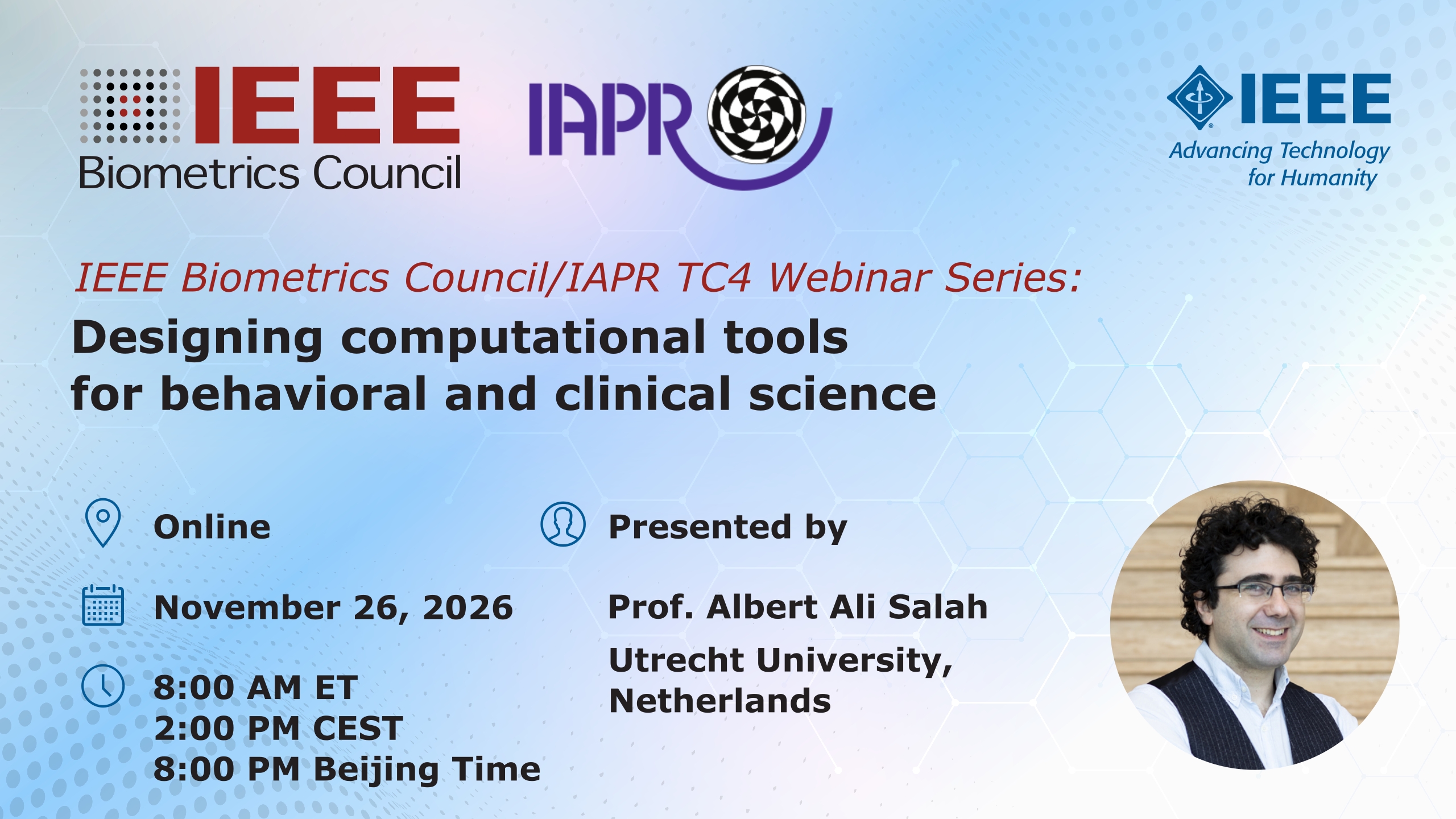
Title: Designing computational tools for behavioral and clinical science
Speaker: Prof. Dr. Albert Ali Salah, Utrecht University, Netherlands
When: November 26, 2026 at 8:00 AM US Eastern Time (2:00 pm CEST, 8:00 PM Beijing Time)
Where: Online (Zoom)
Registration (free but required): https://us06web.zoom.us/webinar/register/WN_uaf_6-kfQq-J7fuFt6coKA
Abstract
About The Speaker
Dr. Albert Ali Salah is professor and chair of Social and Affective Computing at the Information and Computing Sciences Department of Utrecht University. His research is broad, but mainly uses pattern recognition and machine learning for computer analysis of human behavior, with over 250 publications in these areas, including edited textbooks Computer Analysis of Human Behavior (2011, Springer), Data Science for Migration and Mobility (2022, Oxford University Press) and Privacy-Aware Monitoring for Assisted Living (2025, Springer Cham).
Dr. Salah has a PhD in Computer Engineering from Boğaziçi University (2007). He subsequently held positions at CWI, University of Amsterdam, and Boğaziçi University, as well as a one-year visiting position at Nagoya University. His research group at Utrecht University investigates behavior at different scales; looking at individual behaviors (such as facial expression analysis), dyadic and group behaviours (e.g. child-parent or patient-doctor interactions), and at computational social science (e.g. mobile phone based analysis of migration and mobility). He was the coordinator of the Data for Refugees (D4R) Challenge between 2016-2019, and directed the mobile phone workpackage in the HumMingBird EU project. He is also a member of the AI and Animal Welfare Lab in Utrecht.
Dr. Salah was the inaugural recipient of the EBF European Biometrics Research Award (2006), and a recipient of the GEBIP award of Science Academy (2017). He served as a program committee member of over 200 conferences, and as associate editor of several journals, including IEEE Trans. Affective Computing, IJHCS, and Pattern Recognition. He chaired ACM ICMI 2014, ISSI 2015, SPECOM 2019, IEEE FG 2024 conferences, and served in the Steering Boards of ACM ICMI and IEEE FG, and as VP Conferences for the IEEE Biometrics Council. He is a Senior Member of the ACM and of IEEE.